
Your cart (0)
Your cart is empty
Tax included and shipping calculated at checkout
Your cart is empty
Tax included and shipping calculated at checkout

Last Updated: October 13, 2026
Managing a heavy e-bike on technical trails starts with tyre pressure, suspension setup and body position.
Tyre pressure is the biggest handling adjustment on a heavy e-bike, but there's no universal number, it depends on your weight, casing, rim width and terrain. Start a few PSI higher in the rear, then adjust in small steps. The Maxxis Assegai is a popular choice for e-MTB grip.

Most riders set sag once and never touch it again. On an e-bike, that's a mistake. Set sag with your riding gear on and the battery fitted, then tune rebound so the bike settles without bouncing you off line.
Heavy bikes reward an active position: stand up, stay centred and let the bike move underneath. Keep elbows out, heels down and eyes up the trail, shifting weight forward on climbs and back on descents.
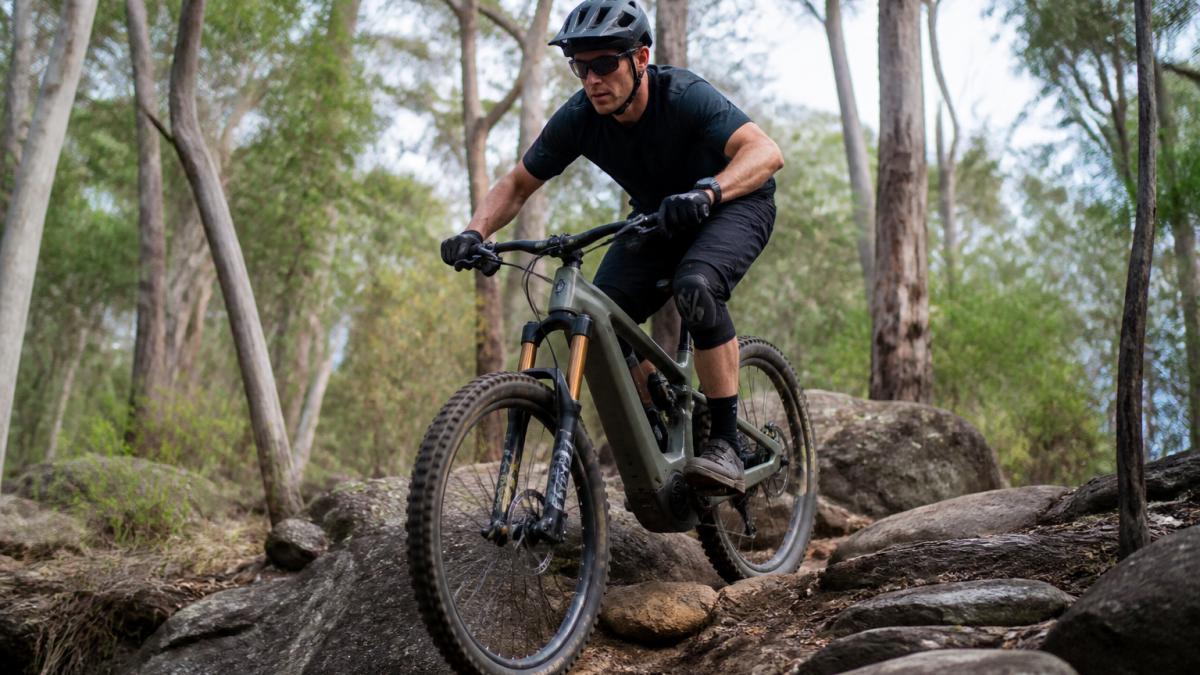
The best e-MTB motor power settings for technical climbs are lower than most riders expect. Use just enough assist to keep momentum, and let traction and cadence do the rest.
Match assist to gradient and grip: low on flowing singletrack, mid for steady technical climbs, high only for short, steep pitches. Drop assist in corners and use walk assist for pushing, not riding. On an Avinox-equipped bike, assist delivery is smooth and predictable on technical terrain.
Keep a consistent cadence, a steady spin keeps the motor smooth and the rear tyre hooked up. Momentum is your friend on a heavy bike, so carry speed into rocky ascents rather than stopping and restarting.
Cornering a heavy e-bike comes down to line choice and weight distribution. Look through the corner, brake before it, then release and let the bike run. Stay off the assist through the apex and get back on the power gently.
Heavy e-MTB braking technique is about control, not force. A heavier bike takes longer to slow, so brake earlier with both brakes together, one or two fingers, front for power and rear for stability.
Good brakes matter more on an e-bike because there's more weight to pull up. The SRAM Maven Silver is a four-piston brake we run on our own Forbidden Druid E, and it suits heavier, faster e-MTBs; the SRAM Code Silver is another solid trail option.

Speed control is really braking-distance management, the faster you go, the more distance you need. Brake earlier than on an analogue bike, release before rough sections so the suspension works, and avoid braking mid-corner.
If you stall on a climb, don't panic-spin, step off, reset, and walk the bike up if needed. If you fall, check yourself first, then the bike for a bent derailleur hanger, twisted bar or damaged lever. Lifting a heavy e-bike is easier with the battery removed.
Skill drills build confidence faster than any upgrade. Practise these on a familiar, low-risk trail before you need them.
A heavy e-bike is still a physical bike. Lift with your legs, not your back, take the battery out for big lifts, stretch after long rides, stay hydrated on hot South West days, and build core strength for balance.
If your setup still feels wrong after all this, bring the bike in. If you're curious about how an Avinox bike rides before committing, we also offer Demo Avinox Ebikes, and we stock Avinox Spare Parts for owners chasing replacements or upgrades.
A full-power electric mountain bike carries its mass low and centrally, which helps stability but makes it slower to change direction and harder to lift over obstacles. Momentum builds quickly on descents, so braking distances stretch and small inputs have bigger consequences. Running suitable tyre pressure, using both brakes together and keeping your weight low and centred all help you work with the weight rather than fight it. Setup matters more on a heavy e-bike than on a lighter trail bike.
The best e-MTB motor power settings for technical climbs are usually a mid-level assist rather than the highest mode. Boost delivers torque instantly, which can spin the rear wheel on loose or rocky ascents and break your traction. A moderate assist level lets you keep a consistent cadence, stay seated or partially seated for rear-wheel grip, and choose your line. Switch to a higher mode only if the gradient or surface genuinely demands it, and remember that settings vary by brand and system.
Use both brakes together, with more bias to the front as grip allows, and brake earlier than you would on a lighter bike. Heavy e-MTB braking technique is about control, not maximum force: apply pressure progressively, keep your weight low and back on steep descents, and release before the corner rather than dragging the brakes through it. Brake pads and rotors wear faster under this weight, so check them regularly. If stopping power feels inconsistent, have the brakes inspected.
Managing a heavy e-bike on technical trails is a skill you build, not a problem you solve with one upgrade. Start with tyre pressure, suspension and body position, then sharpen your braking and cornering with practice. If your bike still feels like hard work, the setup is usually the culprit. Book a workshop service with CB Cycles and we'll help you get your e-MTB dialled for the trails you actually ride.