
Your cart (0)
Your cart is empty
Tax included and shipping calculated at checkout
Your cart is empty
Tax included and shipping calculated at checkout

Last Updated: October 7, 2026
Mountain bike maintenance for beginners 2026 comes down to one habit: a short pre-ride check, a clean and lube after every wet or dusty ride, and a proper service at sensible intervals. Bikes that get ten minutes a week last far longer than bikes that get one big rebuild a year.
Frequency depends on how often you ride and in what conditions.
| Riding pattern | Pre-ride check | Clean and lube chain | Full wash | Workshop service |
|---|---|---|---|---|
| Once a week, dry trails | 2 minutes | Every 2-3 rides | Monthly | Annually |
| 2-3 rides a week | 2 minutes | After every ride | Fortnightly | Every 6 months |
| Wet or muddy conditions | 2 minutes | After every ride | After every ride | Every 3-4 months |
The pre-ride check is non-negotiable: squeeze the brakes, check tyre pressure, spin the cranks, and look at the chain. Wet grit grinds a drivetrain down fast, so clean more often in winter.
Work through the same five points every time: brakes (firm, not spongy); tyre pressure with a gauge; wheels seated and spinning true; drivetrain shifting without grinding or skipping; and headset and cockpit with no knocking when you rock the bike.
Start with a floor pump with a gauge; tyre levers and a spare tube or plug kit; hex keys (2mm to 8mm); a Torx key set for T25 and T30 bolts; a chain checker; chain lubricant; a soft brush and bike-specific cleaner; and a torque wrench once you touch stem and seatpost bolts.
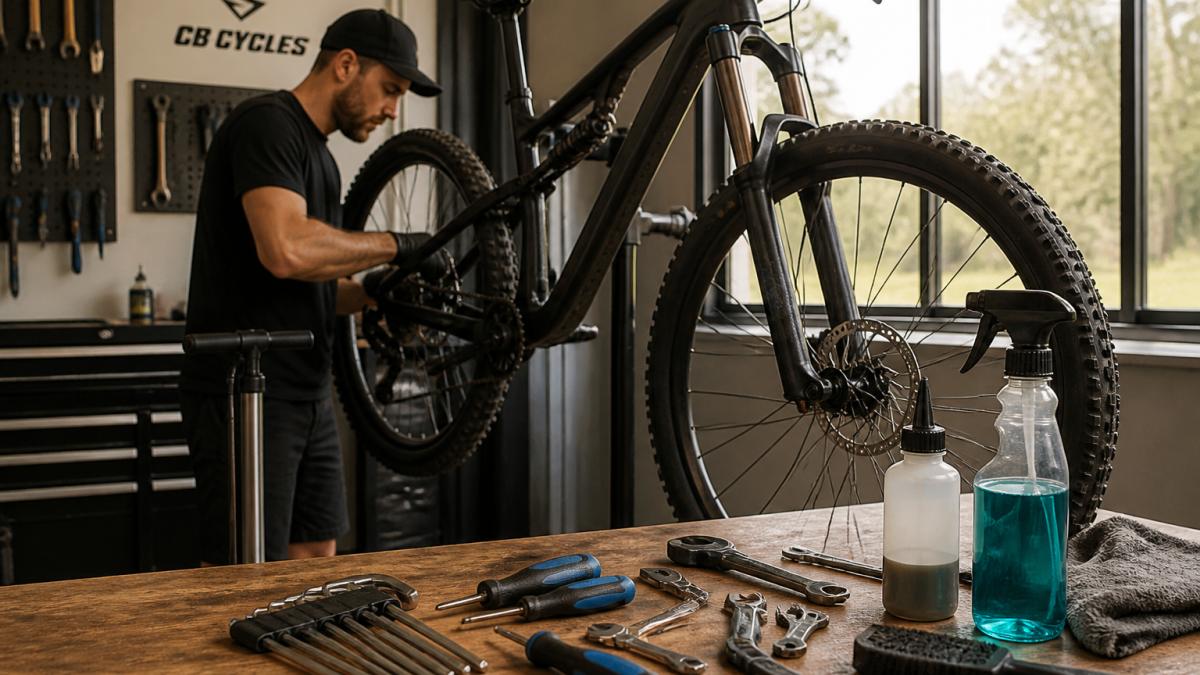
The biggest mistake is blasting a pressure washer into bearings and seals, pushing grit past the seals in your hubs, bottom bracket and headset.
JUICE LUBES DIRT JUICE BIKE is a biodegradable concentrate you dilute to refill your spray bottle. Once clean and dry, JUICE LUBES JL69 GENERAL MAINTENANCE SPRAY 400ML displaces moisture from pivots, bolts and cables.

A worn chain wears out the cassette and chainrings, which cost far more to replace. A chain checker tells you in seconds; most manufacturers specify a wear limit, usually between 0.5% and 0.75% elongation depending on the drivetrain, so check your groupset documentation. Without one, watch for vague shifting, skipping under load, or a chain sitting loose on the chainring teeth.
Apply lubricant to a clean chain, lube over grit just makes grinding paste. Spin the cranks backwards, apply a steady stream along the inside of the chain, let it penetrate, then wipe off the excess.
For dry, dusty conditions, Bike Mix Lubricant 180ml works well. For e-MTBs and high-torque drivetrains, a heavier lubricant such as Silca Chain Lube Drip Bottle_Synerg-E 2oz/59ml (E-bike specific) is worth the extra spend, because e-bike chains wear faster.
JUICE LUBES JL69 GENERAL MAINTENANCE SPRAY 400ML →


How you charge and store a battery affects how long it holds capacity. General principles, which apply across most systems including Avinox: store between roughly 30% and 80% if the bike will sit for weeks; avoid leaving it at 100% for long periods, especially in heat; charge at room temperature; and use the charger supplied with the system. We stock Avinox Spare Parts, and Demo Avinox Ebikes are available.
Replace pads when the friction material is worn to roughly the thickness of a coin, or sooner if stopping power drops, squealing persists, or fluid weeps around the caliper. Wear rates vary with terrain, rider weight and braking, so check monthly. Replacement is straightforward: push the pistons back with a clean tyre lever, fit the new pads, pump the lever, then bed them in.
Bedding-in transfers a thin, even layer of pad material onto the rotor, giving full, consistent stopping power. Get up to moderate speed on a safe stretch and brake firmly but not to a full stop, repeating several times with gradually increasing force. Avoid dragging the brakes or stopping completely, which can leave uneven deposits.
Safe at home: cleaning and lubricating the chain, tyre pressure, replacing brake pads, tightening bolts to the correct torque, punctures, and basic gear indexing. Leave to a workshop: suspension servicing, brake bleeding, wheel truing beyond a minor tweak, bottom bracket and headset bearing replacement, and e-MTB motor and battery diagnostics.
Sealant dries out over time, so most riders top up every few months depending on climate. Champions Choice Sealant is Australian-made, uses microfibre technology to seal punctures, and is compatible with CO2 inflators. If you are constantly topping up or losing pressure, it may be time for new sealant, tape or a fresh valve.
You do not need to become a mechanic, you need a routine, a small kit, and the honesty to know when a job is beyond you.
Maintaining a mountain bike well comes down to consistency, and consistency is easier with the right tools and a workshop you trust.
Focus on four things: a pre-ride check of tyres, brakes and quick releases; cleaning your bike after muddy or dusty rides; lubricating the chain; and checking for wear on brake pads and tyres. These cover the safety-critical basics. Anything involving suspension internals, bearing presses or motor systems is best left to a workshop. A simple routine done consistently beats an occasional deep clean.
It depends on how and where you ride. A bike used weekly on wet South West WA trails will need more attention than one ridden occasionally in dry conditions. As a rough guide, check the chain and brakes monthly, clean after every wet or muddy ride, and book a professional service at least once a year. E-MTBs and bikes ridden hard may need servicing more often. Check your manufacturer's recommendations for your specific model.
Book a workshop service if you notice grinding brakes, gears that won't shift cleanly, a creaking bottom bracket, suspension that feels harsh or leaks oil, or any motor or battery warning on an e-MTB. These symptoms usually point to wear or adjustment that needs proper tools. If you're unsure, bring it in for a check. Diagnosing the issue is often quicker than guessing at home.